
Aeternum Launches Its Beta and Invites 100 People to Test Its Private Family Memory App
Press release · For immediate release
Aela and Memoria bring AI to family memories, built to work only with what each person has been given permission to see.
EDMONTON, AB — October 8, 2026 — Aeternum, the Edmonton-based private platform where families keep and share their memories, has launched its Beta, and is inviting 100 people to test its new mobile app for iPhone and Android before the official release.
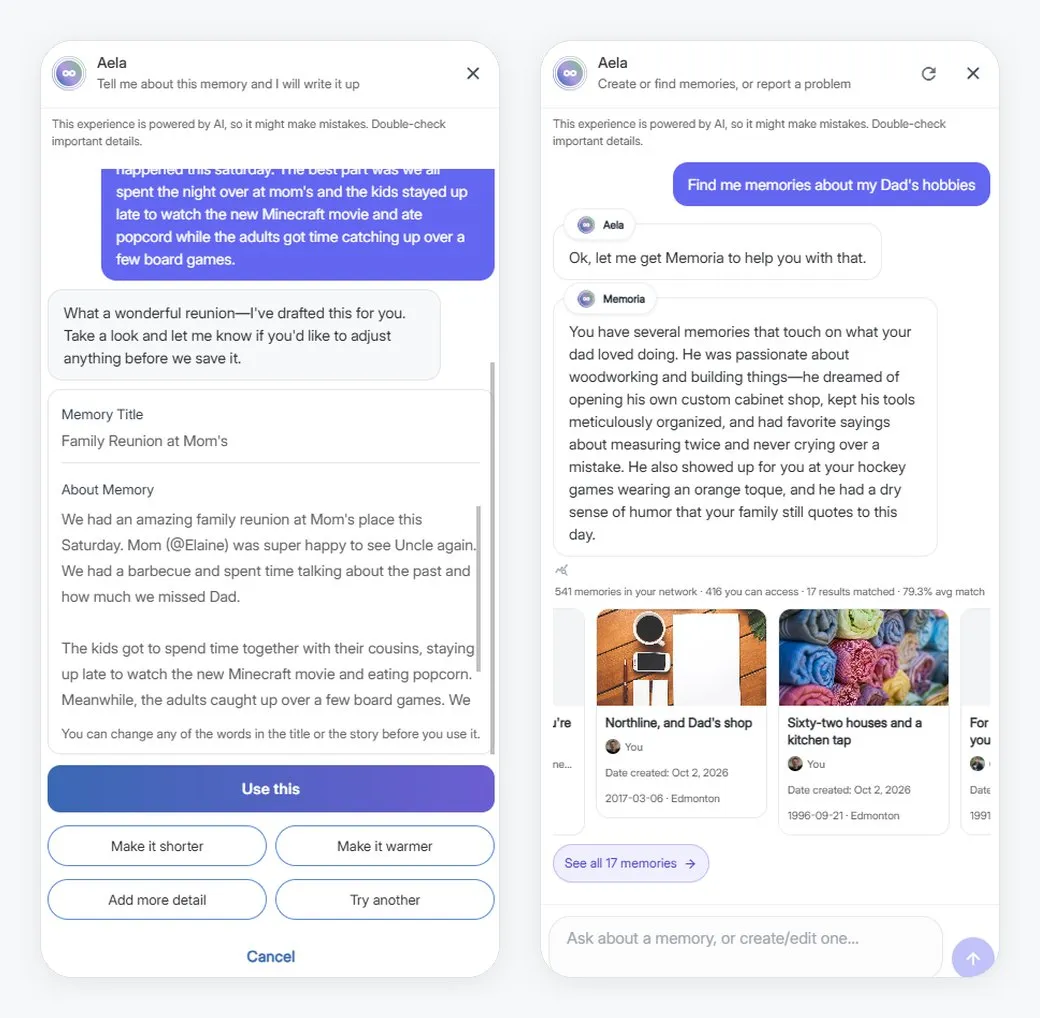
The Beta brings two AI features to the platform. Aela is a companion that lives across the app: people describe a moment in their own words, the way they would tell a friend, and Aela turns it into a memory they can edit and share with exactly the people they choose. Memoria answers questions about a family’s past, like “What were Dad’s hobbies?”, by drawing on the memories the family has saved.
What sets Memoria apart is the order in which it works. Before it answers, Memoria checks who is allowed to see each memory, and only then hands those memories to the AI. In Aeternum’s demo family, Memoria searched only the 416 of the network’s 541 memories that the person asking could see. Aeternum’s AI provider, Anthropic, is bound by commercial terms that don’t allow customer content to be used to train its models.
“We wanted families to be able to ask questions about their history and their memories, but we refused to risk anyone’s privacy permissions to do it,” said Aaron Tong, Founder and CEO of Aeternum. “We should not need to sacrifice our own privacy for the sake of digital connectivity.”
The Beta also adds:
- Custom Circles: create and name your own circles, so each memory reaches the right people, whether that’s your closest family, lifelong friends or the cousins you only see at reunions.
- The Archive: one place to browse, sort and manage every photo, video, recording and document in your vault.
- Faster uploads: uploads and processing are faster, and more file types are supported.
- Stronger family connections: easier invitations, and relationships that stay accurate from both sides.
Aeternum has no public feed, no ads and no algorithm deciding who sees a family’s memories.
100 places to test on mobile
Aeternum’s native app for iPhone and Android uses the same account and the same private vault as the web, so there is nothing to move. The company is inviting 100 people to use it on their own phones and tell the team what to improve before the official release. Applications are open at aeternumproject.com/100tester.
Designing for every generation
Through Project Aegis, supported by the National Research Council of Canada Industrial Research Assistance Program (NRC IRAP) and Mitacs, Aeternum is adapting its design to the needs of older adults. On October 1, the team demonstrated Aeternum to seniors at AGE-WELL’s AgeTech Discovery Day in Edmonton, where the seniors in the room named fraud, and the exploitation of seniors through technology, among their biggest worries.
“With AI, we either combat fraud with AI, or we keep our personal information away from publicly accessible places,” said Tong.
About Aeternum
Aeternum is a private, ad-free platform where families keep their photos, videos, voices and stories, and share each memory only with the people they choose. It is built in Edmonton, Alberta. Families can start at app.aeternumproject.com.
Media contact: Aaron Tong, Founder & CEO · marcom@aeternumproject.com · Photos, logos and background: Media kit